If you’re hoping to rally people to your side on a predominantly francophone forum, why have you not tried to translate your message before posting, asked someone for help, or looked into one of the many translation tools out there? Like, members can post in any language they want, but considering your message, just doesn’t seems particularly conducive…
Also, people tend to tune out large unformatted wall of text. Easy to dismiss as ranting.
En résumé : toutes les réponses imaginable pour être contre le TGV… Ça va couper les liens nord-sud, coûter trop cher, raser la campagne, pas desservir assez de villes.
C’est comme si aucun autre pays n’avait jamais fait de TGV auparavant… C’est comme si nous n’avions pas fait pire avec des autoroutes mur-à-mur qui ont des emprises encore plus larges !
Language debate aside, I’m willing to entertain a discussion about this.
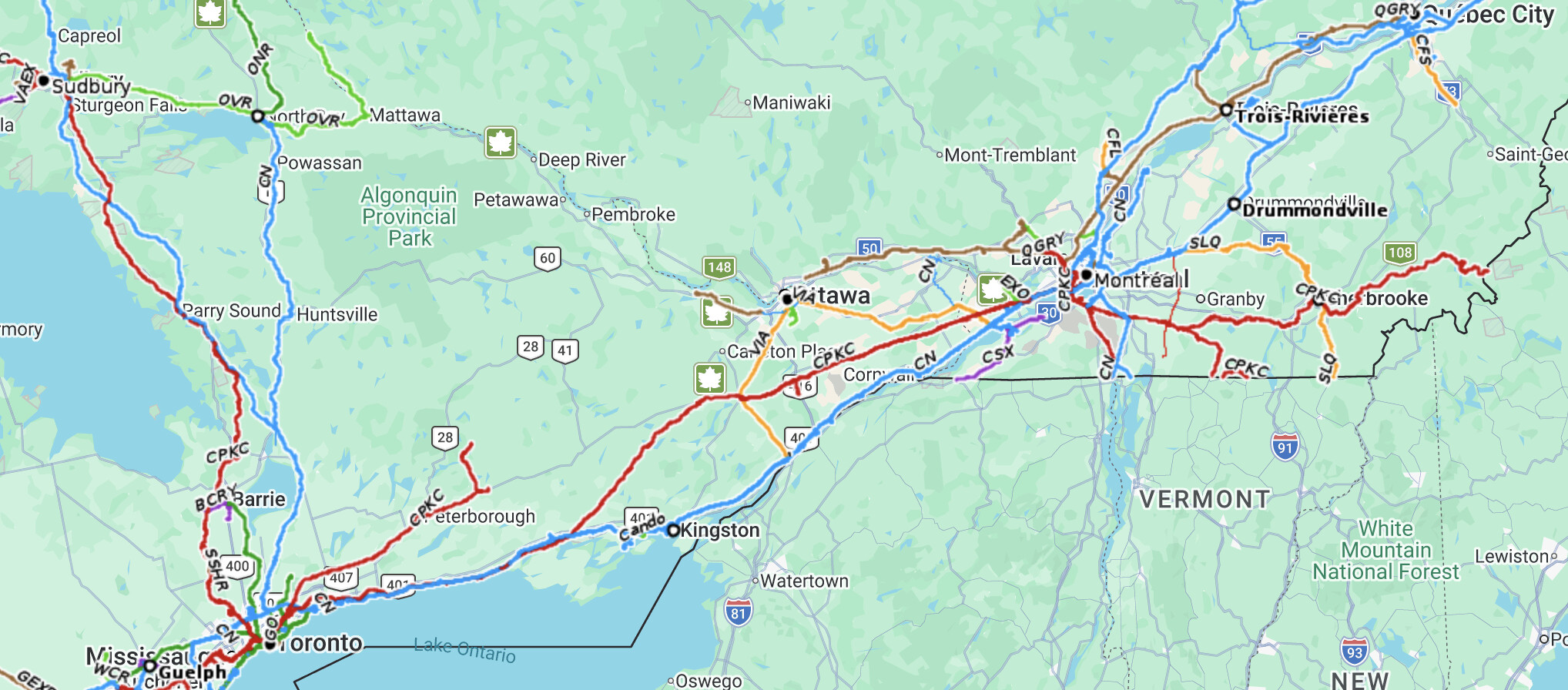
Going with what you suggested about a newly upgraded HFR system on the existing VIA network, in an ideal world, yes it would indeed be cheaper and easier to upgrade the infrastructure for trains to be able to roll with faster speeds. However, VIA currently owns a very small portion of their network between Montreal and Toronto, most of which is owned by the freight train companies Canadian Pacific, the red lines you see in the image below, “CPKC”, and Canadian National, the blue lines “CN” (source). The current railways are not very well maintained, and contain many curves (that you can see if you zoom into the tracks on the map) that restrict train speeds even at the best weather conditions. Speeds of 240 km/hr are very hard to reach given those conditions, and that is without considering CPKC and CN’s ownership of said tracks.
Because CPKC and CN, private companies, own the tracks of the corridor between Montreal and Toronto, the priority is given to their freight trains rather than VIA’s passenger trains, unlike the NEC which is owned by Amtrak and other transport agencies like Metro-North, CDOT and MassDOT. The NEC has not seen large through freights since the early 1980s, and although some sections still see freight, they are in much smaller size, quantities, and they do not have priority over Amtrak’s trains, even if a few freight companies (Norfolk Southern and CSX) partially own some of the tracks. This is why it is relatively easier for Amtrak to proceed with upgrades, since they have ownership of most of the NEC.
Upgrading VIA’s network to the high frequency system and higher speed we desire, similar to Acela and other NEC trains, requires buying CN and/or CPKC’s tracks and making significant changes to the rail placement in this part of the Quebec-Windsor corridor. VIA has already tried negotiating with CN to just install additional tracks to reduce their delays and boost the number of passenger trains, which simply lead to stalling from CN’s part – this article from the Financial Post explains a short summary of this conflict. Those tracks, especially between Ontario and Quebec, are extremely profitable to those private companies – why would they ever want to give them up or give more to VIA, an “unprofitable” crown corporation?
Discussions like this have stalled for decades, especially since the privatization of the railway companies, thus giving up the rail network from the public to the private sector. It’s no wonder ALTO is focusing on building its high speed rail on its own right-of-way – because the rail corridor between Montreal and Toronto is privately owned, unlike the NEC in the states, it is extremely difficult to negotiate for better passenger service between the cities, or even for the small towns in between.
Canada has been missing a fast railway link between its biggest cities for decades: we’re still the only G7 country to not have a high-speed rail network. Other countries who have built their own high speed rail network have definitely seen the fruits of their labour flourish, despite the initial controversies and worries. I am definitely onboard for a much better regional rail network in the style of France’s “TER” or Switzerland’s extremely punctual and reliable SBB (a country whose railway network is also primarily owned by their federal government - the Swiss Confederation), however if it means having nothing vs. having a modern high-speed rail network across the Quebec-Windsor corridor that contains roughly 50% of the country’s population, I’d rather pick the latter.
It is also a question of profitability and competitiveness of the train vs driving or flying.
The HFR’s speed is not competitive enough, notably between Montreal and Toronto vs either driving and thus having the car available once at destination or flying.
Also, as BootsAndCats explained above, even for HFR it is necessary to build out new dedicated tracks, mostly in new alignments. It is "“marginally” more expensive at this point to buildi for 300 km/h speeds instead of 200 km/h as electrification and grade separation are still necessary.
The HFR project would have been a waste of money and would have brought minimal benefits when compared to it’s cost, to a point where the funding would have been better used in corridor cities airports upgrades, transit projects in Toronto/Ottawa/Montreal and upgrades to the 401-417-20-40 highways, along with some subsidies to intercity bus service.
Going for a true HSR is a no brainer there.
That being said, there is howver a quite fair point in serving Lakeshore communities, notably Kingston and a good compromise would be to build some intermediate stops served by some “local” service as seen in Japan and France.
Thank you for the thoughtful reply BootsAndCats. I just find it hard to believe there isn’t a win-win solution the government and the freight companies can arrive at that improves both the freight system AND the passenger system. As you say, the freight network is run down. Upgrades, diversions and long sidings that allow freight to wait and give priority to passenger trains - couldn’t this be enough to get travel between Ottawa and Toronto down to 3 hours? Is 3 hours really too much for people so they insist on driving or flying? Yes, it would require $billions, but Alto is talking about numbers approaching $100billion, and this is even before adding in return on capital. Plus it wouldn’t need to be like this all the way - the first leg of the track could be new track coming down the 416 from Ottawa to the St Lawrence.
I’m only interested in dialogue with people who are both interested and open minded, and I’ve already found a few of those. I must ‘right click’ on my favourite translator a dozen time a day to read things in other languages. If any translation reads hard I might try another. But I’m not comfortable posting original text in a language I don’t know, sorry.
You need to understand that these companies are not interested in the long term, they only care about financial quarters of shareholders. While it is true that improvements of their corridors could be beneficial for them in the long term, it will definitely not be in the short term with a lot of perturbations of their activities.
These improvements could also mean they will be forced them to adopt practices that are more efficient, but also less profitable and it is nearly impossible that they will allow electrification of their own tracks.
So with all that said, do I say that what you propose is impossible? Absolutely not, but it’s clearly not something that can be done fast, at a reasonable cost and without a huge battle with the fret companies which the government right now is not willing to do. Personally, i think the best we can hope, even in the long term, is to force companies to let us build tracks in their right of way and reorganize or buy some corridor to include passagers for more suburban as well as local intercity services and even that is not short term.
So at this point like you see it’s just better to build dedicated tracks either in or outside the right of way, but since you build new tracks, it doesn’t make sense to spend that much and not electrify them. Thought since you electrify it again doesn’t make sense to not go directly full speed and for this the current fret right of way is impossible to use especially if you want to serve Ottawa/Montréal/Québec in one line.
The good news is that both can be done! We could imagine the HSR being the express service between Montréal and Toronto while a more slow and local 200 km/h capable train do all the lakeshore cities that also need passanger service. The thing is that right now passanger rail have no bargainning power to the government so it is not willing to fight for it. With the bringing millions of passangers every year it will maybe finally be the ticking point that shows that you have a demand for passanger rail in Canada encouraging the government to finally take the bigger fight with freight to make place for passangers too for more regular 160 to 200 km/h surburban and intercity services.
I understand the fear and questionning, but being in the industry since a while, trust me when I say that you really have no way to negociate what you want with the fret companies. Especially that even at 250 km/h a 3 hours (which is the minimum to be competitive with the time to get to the station) may not be possible and thus dramatically reduce the number of passangers. I know it will be difficult for some people, but really respectefully I think it’s more fear than actual harm, yes ALTO will be a sealed corridor, but it will be far, far more easier to add bridges passage under it than an highway. You also have ways to make passage for the fauna, pedestrians and snowmobiles that are way, way cheaper than road bridges or tunnels.
I really understand you in the fact that I also want to see an improve passanger rail network, especially suburban ones around our biggest metro of Montreal and Toronto, and in this vain I’m the first to oppose REM proposal in my homwtown that should be instead modern suburban rail. Thought I have the humility to recognize that it is a project with a really long term scope. This is why in the case of the HSR project this approach of long term upgrades doesn’t work, it have too much risks, unknows and actors to contain with that could derail the project.
For a first trully modern line, you need to go fast, cheap and effecient to make a concept that will allow extensions and other services to flourish with the proof that passanger rail can work in Canada. The HFR project seems appealing on the surface, but in reality in could have never work. I know a lot of people will be attracted to it because it promise no changes to a lot of people and changes can be threathening, but really in our current rail context it is more of a distraction that could bring us back to zero and add multiple decades before we could see a true modern passanger rail system in Canada.
With freight trains kilometers long, it’s always much easier to make the passenger trains wait. It could have been different if all the old tracks were still there, but with most turned to parks, bike paths or back to residential buildings, there’s no safe way to make a HFR at 240km/h when freight trains go at 30km/h and takes kilometers to stop and go out of sidings !
In either case, HFR or HSR, you need new tracks in a new corridor. And with 240km/h HFR, you better have bridges instead of crossings to prevent accidents ! Once there, you just invest a bit more to get HSR and get a train that can compeat against planes. And after you get a passenger only corridor, it’s easier to add local services if needed.
What you say is true. Except my main worry is VIA is already only a shadow of what it once was, and Alto will further starve it of funding and ticket sales. All the high paying end-to-end passengers from Montreal and Toronto won’t be supporting it anymore after Alto starts running, ending any dream of an integrated rail network. Alto isn’t a network though the Minister of Transport keeps calling it that - it’s just one line - so people can have ‘lunch in Toronto and dinner in Montreal’ (this is really how the government is marketing it)…. apparently that’s one of humanity’s big priorities at the moment.
Let’s be honest here, I think VIA wouldn’t even be close of having the skills and expertise that ALTO got, also the companie in the recent years made… let’s say… questionable choice regarding costumer experience. So just let’s say it’s very unlickely that VIA would have got the backbone of designing, building and operate HSR. Considering how the canadian rail industry have a conservative mind I think it’s actually a good thing that we start from scratch.
I think you really have a pessimistic view of the project, on the contrary, having a true modern HSR that attract millions of passangers and that work will be the perfect thing to show to politicians that rail work and people want it. It will finally bring a weight in the government where other other towns or regions will be like: “we want that!”. Don’t say we should build HSR everywhere, but it will at least encourage conventional rail.
A new society is the perfect opportunity to bring new talents, emerge with new ideas and create a culture that favorise innovation rather than what we already know just the fact we talk of a 13 km tunnel is a miracle in our canadian context.
False ALTO is a crown corporation, exactly like VIA, that take order from the governement and what is planned is definitely a network. Even if on the map is one line, you will have different service patterns, probably different types of trains like express or regional, the magic of being on their own tracks is that you can decide! Sure I’m not a fan of P3, but it’s better than nothing and the tracks will ultimately be own by the government so at this point it’s nitpicking.
This my guy it’s called PR.
They don’t say because it will be the majority of the use of an HSR network, it’s just to give a concrete image to people of what it will look like, but it really tell is that you will finally be able to move between cities in one day which is a game-changer.
What they just want to say is that people that actually need to move between cities will be able to do it an a day by train which is impossible by now.
Thank you for your open-mindedness. I feel Canada is missing out on a real opportunity to solve many problems simultaneously - regional development, a great VIA network, efficient freight infrastructure, and all systems integrated properly. One example, the Canadian government just paid for the new Gord Howie bridge between Windsor and Detroit. 10 lanes of traffic and no provision for rail! It’s like renovating a house and starting with new drywall and painting, then moving some walls and re-wiring the electrics. Yes, you can do it, but the whole thing takes longer and costs more.
Well about the Gordie-Howe bridge they should had think about including a space for mass transit. Like what have been done with Champlain bridge with the REM.
In the same time an improved rail link Windsor-Detroit if done would be far away in the future.
The window of opportunity to include the REM on the Champlain bridge coincide exactly with the decision for the REM and the construction of the bridge it was a perfect match.
I agree in theory, but in practice for the case of the HSR project this will probably only lead to increase scope, timeline and costs that will ultimetaly cancel the project because of political winds.
If you really want trains to succeed in Canada ALTO is the best thing we have and cancelling it in favor of a maybe we can do that instead is at best naive and at worst destructive for any hopes of seing HSR in Canada.
I really feel you because I was with the same mentality before, but I had the humility at some point to realize that I was wrong and that the best course of action is to build ALTO with his own right of way and to use the momentum to then improve VIA and other suburban services.
Non mais imagine relier les réseaux de VIA et Amtrak et pouvoir faire Montréal Toronto en TGV, puis prendre un train plus lent mais direct jusqu’à Detroit, et ensuite Chicago, ou encore mieux, direct de Toronto à Chicago.
Traverser la frontière en train de l’Ontario au Michigan pourrait devenir réalité dans deux ans.
Photo : Radio-Canada / Jacob Barker
Radio-Canada
Publié le 28 juin 2024 à 14 h 11 HNE
Une liaison ferroviaire transfrontalière entre Windsor et Détroit pourrait voir le jour dans deux ans, selon le PDG de VIA Rail, Mario Péloquin.
Cette liaison, inexistante actuellement, permettrait la création d’un trajet de Chicago à Toronto. M. Péloquin a dit en point de presse à Windsor qu’il travaillait étroitement avec Amtrak, le transporteur ferroviaire américain, et les services frontaliers des deux pays pour faire avancer le projet.
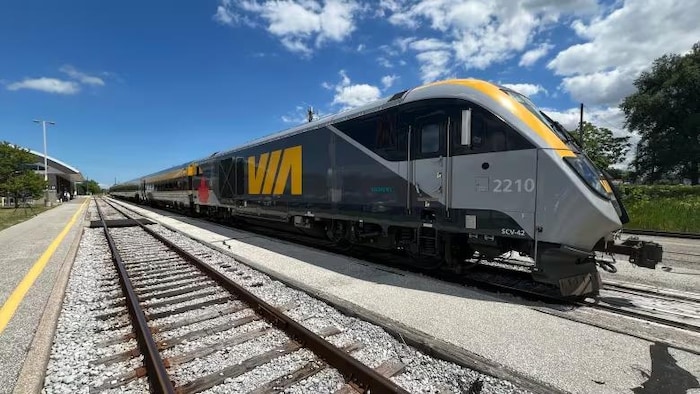
Le projet de liaison ferroviaire transfrontalière entre Windsor et Détroit avance, selon le PDG de VIA Rail, Mario Péloquin.
Photo : Radio-Canada / Jacob Barker
Il y a du travail à faire pour que la station de Windsor devienne un lien transfrontalier. Les plans sont en place et vous verrez des trains d’Amtrak à Windsor pour des transferts avec les nôtres probablement dans une ou deux années, a précisé Mario Péloquin.
Douanes et frontières
Des améliorations doivent être apportées à la station de train de Windsor pour y accueillir un service des douanes. Ces travaux pourraient coûter une dizaine de millions de dollars, selon le maire de Windsor, Drew Dilkens.
Le PDG de VIA Rail dit travailler pour faire avancer les choses le plus rapidement possible avec les différents gouvernements impliqués.
Il n’existe pas de service de train transfrontalier dans cette région depuis 1971. Le dernier train qui reliait Toronto à Détroit a quitté la gare pour la dernière fois en 1967, année du centenaire du Canada.
Ces commentaires ont été faits lors d’une annonce sur le remplacement des trains utilisés depuis 77 ans sur le corridor Toronto-Windsor pour 2025.