c’est peut être l’équivalent d’une des rares bonnes choses qu’avait faite Geneviève Guilbault : limiter la valeur de l’expropriation à la valeur d’aujourd’hui et non à la valeur hypothétique dans 15 ans si jamais le projet xyz est fait.
3 « J'aime »
Je vous ai copié collé l’article
OTTAWA — The Carney government is proposing to grant the Crown corporation behind the high-speed railway between Toronto and Quebec City sweeping new powers to accelerate the acquisition or expropriation of land for the project.
Article content
A new High-Speed Rail Network Act also proposes to exclude the massive railway project from review by the Canadian Transportation Agency by deeming it de facto approved and barring the agency from rescinding the approval.
The proposed act is tucked away in the hundreds of pages of the Liberals’ bill to implement the 2025 budget tabled Tuesday.
The legislation offers a first glance at how Prime Minister Mark Carney’s government intends to deliver on its commitment to reduce red tape and speed up the building of major projects.
Article content
The new act contains sweeping changes to how the railway project — estimated to cost between $60 and $90 billion — will be reviewed all the while boosting the government’s land acquisition and expropriation powers required for construction.
Article content
The project promises to develop roughly 1,000 kilometres of fully electric rail dedicated to high-speed commuter trains that will run between Toronto and Quebec City. This summer, the Carney government designated the high-speed railway as a “transformative project” under its new Major Projects Officeand promised to cut the time before construction from eight to five years.
Article content
Alto, the Crown corporation behind the project, says the trains will hit speeds of up to 300 km/h and will cut travel between certain cities by half compared to existing Via Rail service.
Normally, major transportation infrastructure projects would be subject to two key reviews agencies: the Impact Assessment Agency of Canada (IAAC) and the Canadian Transportation Agency (CTA).
But with the bill proposing that the high-speed rail be automatically deemed approved by the CTA, the project would only be subjected to an environmental assessment by the Impact Assessment Agency.
Article content
Legislating approval of a project speeds up the process significantly but has been historically received with much hostility by opposition Parliamentarians.
Article content
Lavagnon Ika, a professor of project management at the University of Ottawa, said that the legislation brings the government into “uncharted territory.”
Article content
“These are sweeping and unprecedented powers being given to the cabinet to kind of… pre-approve any mega project without much scrutiny from independent regulators,” said Lavagnon Ika, who is also the director of the Major Projects Observatory.
Under the proposed bill, the IAAC process would also be modified for the railway project if the legislation passes untouched. Instead of the IAAC reviewing and conducting consultations on the project as a whole, the bill proposes to cut it into segments of up to 50 kilometres which would each be reviewed and approved individually.
Article content
The bill also appears to suggest the review will be led by the IAAC itself instead of an independent review panel. The latter can be set up when a minister believes it to be “in the public interest,” though the time for a final decision doubles to 600 days on average, according to the agency’s website.
Article content
In a statement, Transport Minister Steven McKinnon’s spokesperson Marie-Justine Torres, said the goal of the proposed law is to “reduce duplication, streamline government processes and ensure that each segment of the project is subject to the Impact Assessment Process while fully respecting Indigenous rights.”
Article content
Her statement did not explain why the government decided to break up the project’s environmental assessment into segments or why it was bypassing review by the CTA.
If the bill passes as such, Alto will also be able to purchase or expropriate land necessary for the project faster. The bill proposes to allow Alto to request the minister of public services expropriate land without first trying to negotiate the purchase with the owner.
Article content
It also proposes to remove the duty for the minister to hold public hearings if someone objects to a notice of expropriation.
Article content
Instead, the minister must decide within 30 days of the notice of expropriation if the government is maintaining or abandoning the claim. The minister must only state reasons for the decision if the objector requests them in writing.
Article content
The bill also proposes to streamline Alto’s ability to issue notices of right of first refusal of the sale of land that will be part of the rail network. It does the same for notices of prohibition of work, which prevent a landowner from making any changes to it other than to “maintain its normal functional state”.
“The expropriation measures have been put there so that basically government… stays in control,” Ika said. “’You may not like it, but we proceeded’ is basically what they mean.”
Ika, who has spent his career studying large-scale projects and their failings, said there is no doubt that Canada’s approval process for major projects is so cumbersome and time-consuming that it leads to long delays and inflated costs.
Article content
But that doesn’t mean the government can forego consultations and reviews completely, particularly with Indigenous communities, he cautioned. The Carney government is in a “delicate dance” to get the balance right.
“My advice to them is: wait a minute,” he said of the government. “If you use too much of your authority, then you control the project and that’s a win for you. But at the same time, it might backlash in terms of democratic accountability and that’s going to be a loss for you.”
2 « J'aime »
Commentaire de Garth Turner sur son blog (ancien député Conservateur sous Mulroney et Harper) au sujet d’Alto:
It’s called the High-Speed Rail Network Act , and forms part of Bill C-15, “An Act to implement certain provisions of the budget tabled in Parliament on November 4, 2025.” The first reading took place in the House of Commons last Tuesday.
“Ottawa has thrown out the normal safeguards that protect homeowners from abusive expropriation,” says Gabriel Giguère, of thinktank MEI. “Under this special system for VIA Rail, Canadians are no longer treated as sellers, but as people to be dispossessed.”
“Steamrolling property owners is no way to treat Canadians, and trying to bury such an erosion of property rights in an omnibus bill only adds insult to injury. Unfortunately, the fact that Ottawa feels comfortable making such an exception once increases the likelihood that it will do so again.”
It’s true. Read the Act.
The Alto legislation guts the existing Expropriation Act in order to hurry-up the project. It removes the obligation of government to negotiate a fair settlement for land that’s being taken. There will be no good-faith purchase offer, which the owner can effectively dispute. “If it decides a property is needed for its project, it can get the Minister of Transport, Steven MacKinnon, to directly issue a notice of expropriation,” says MEI. “It does not need to send an offer, negotiate, or demonstrate that a purchase attempt was made.”
Public hearings can be waived. And the feds’ new Alto corp can order that a piece of land be frozen for up to four years – even without buying it – in case it may be required later for trainy stuff. In the meantime the owner is barred from changing it in any way, and must only maintain it.
Owners can file an objection (for what it’s worth) and must do so within 30 days. But the government then has two years to respond. “They will be able to take your land, freeze your property, and cancel your sale agreements, all without negotiation,” adds Giguère.
2 « J'aime »
Mulroney cut VIA service by 55% and harper continued those cuts, so quite frankly I dont think we should take any person who served under them seriously when it comes to passenger rail.
15 « J'aime »
I don’t see how this is correlated. Are his arguments valid or not, that’s all there is to it.
2 « J'aime »
His arguments are not valid, because the massive disinvestment in rail in this country, led by the prime ministers he served under, means that now we need to accelerate this scheme by any means necessary. In other words; the federal conservatives have made their bed by rejecting every sensible rail project in this country, now it’s time for them to lie in it and face the consequences of their actions.
7 « J'aime »
I don’t understand this argument, makes no sense to me. First of all, there was a massive Liberal period between both governments which could have restored VIA’s budget. I don’t recall that happening.
Are those people potentially expropriated (ie: facing the consequences) purely conservative?
Also, in my opinion, it’s absolutely stupid and damaging to ignore off-the-cuff someone’s arguments purely because they’re on the other side, politically or otherwise. That’s the type of behaviour that leads to polarization.
It’s about rights and due process.
Note: I’m not saying Mr. Thurner is right or event that his arguments are valid, but they’re worth noting at the very least.
7 « J'aime »
Reading the act in comparison to the previous act, yes, he makes valid points. The counter argument is that the existing process and safeguards at the federal level were not well suited to a project of the scale of ALTO.
Now, my argument against these changes would be that federal expropriations are fairly rare, and it would probably make just as much sense for ALTO to do the expropriations under provincial law instead, with a well exercised set of rules and safeguards, in particular in the case of disagreement on market valuations.
1 « J'aime »
Le groupe de recherche TRAM (Transportation Research at McGill) s’est penché sur les perceptions de la population sur le projet ALTO.
6 « J'aime »
Selon le trajet que je vois sur la carte le train passerai par montreal et ensuite par Laval pour aller vers Ottawa.?
Quelle carte? La note politique du groupe TRAM?
Oui cette carte pourquoi le trajet est quebec , trois rivieres, montreal , laval , ottawa ?
Ça m’étonnerait fortement que cette proposition soit réaliste considérant le nouveau terminal de contrecoeur et le fait qu’il faudrait un nouveau pont au-dessus du saint-Laurent.
TGV Québec-Toronto : Alto ne confirme pas un lien avec la gare Union | Radio-Canada
TGV Québec-Toronto : Alto ne confirme pas un lien avec la gare Union
Résumé
Accéder à la section Commentaires
Ouvrir en mode plein écran
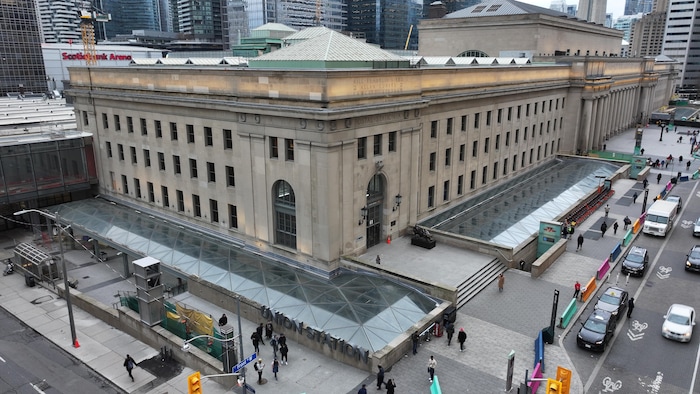
La gare Union, au centre-ville de Toronto.
Photo : Radio-Canada / Patrick Morrell

Publié à 8 h 08 HNEMis à jour à 11 h 46 HNE
Écouter l’article | 4 minutes
La version audio de cet article est générée par la synthèse vocale, une technologie basée sur l’intelligence artificielle.
La filiale Alto ne s’engage pas à lier le train de grande vitesse Québec-Toronto à la gare Union, au centre-ville de la Ville Reine. Le PDG de l’organisme responsable de livrer le projet ferroviaire, Martin Imbleau, s’est contenté de dire mardi que l’objectif était d’avoir une gare « dans les environs de la gare Union ».
M. Imbleau a fait les commentaires lors d’un témoignage dans le cadre d’une réunion du Comité sénatorial permanent des transports et des communications en compagnie, entre autres, de Vincent Robitaille, sous-ministre adjoint à Transports Canada.
Interrogé par une sénatrice à savoir s’il avait une préférence entre un arrêt ou non des trains à Union, M. Imbleau a répondu en souriant qu’il en avait une, mais qu’il ne la partagerait pas aujourd’hui.

Ouvrir en mode plein écran
Martin Imbleau, chef du projet de train à haute fréquence de Via Rail (Photo d’archives)
Photo : The Canadian Press / Christinne Muschi
Nous allons tenter d’éviter de nous tenir à une solution, puisque cela pourrait causer plus de spéculation et plus de coûts pour les contribuables, donc nous allons conserver nos options aussi longtemps que possible. Mais l’intention à Toronto est d’être près d’Union si c’est faisable et économique.
Une citation deMartin Imbleau, chef de la direction d’Alto
Le sous-ministre adjoint Robitaille a par la suite assuré que la station ne serait pas loin dans les banlieues. Le gouvernement du Canada a demandé à Alto d’avoir des stations dans le centre-ville des villes, mais à ce moment-ci, nous allons laisser les experts faire leur travail, dit-il.
Publicité
Dans un courriel, Benoit Bourdeau, porte-parole d’Alto, déclare qu’il y aura une gare au centre-ville de Toronto. Le secteur de la gare Union fait évidemment partie des options qui sont étudiées. Le travail débute et il est trop tôt pour se prononcer sur un emplacement précis, écrit-il.
L’arrivée d’un train à grande vitesse dans un environnement urbain hautement densifié comporte des enjeux techniques et opérationnels, qui nécessitent des études détaillées et un travail étroit avec nos partenaires, notamment Metrolinx, explique M. Bourdeau.
M. Imbleau affirme qu’il compte collaborer avec l’agence de transport provinciale Metrolinx, qui est propriétaire d’une partie de la gare du centre-ville. Mais notre intention est d’être aussi indépendants et fiables que possible, a-t-il ajouté.
Ça serait important que ce soit la gare Union
Pierre Filion, professeur émérite d’urbanisme de l’Université Waterloo, affirme qu’il serait important que le train commence et termine son trajet à la gare Union, car cette dernière offre la meilleure connectivité avec les réseaux de transports en commun.
À la gare Union, vous avez le métro, vous avez des trains GO, alors pour quelqu’un qui sert du transport en commun pour utiliser le TGV — ce qui va être une très grande partie, sinon la majorité des gens qui vont utiliser le TGV — c’est l’endroit où être.
Une citation dePierre Filion, professeure émérite d’urbanisme à l’Université Waterloo
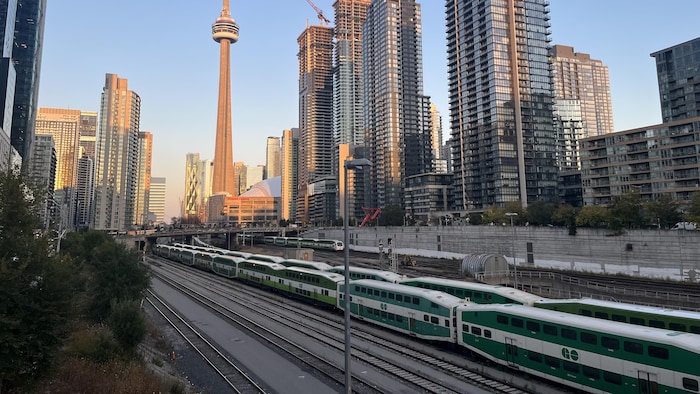
Le professeur note cependant qu’il comprend l’hésitation des consultants embauchés pour planifier l’arrivée des trains à Toronto. La gare Union est très occupée, elle est très achalandée, ses voies sont très occupées. Et puis, l’espace est limité aussi, dit M. Filion. Il faudrait ainsi, selon lui, construire une nouvelle section dans la gare, afin de ne pas retarder l’arrivée et le départ du TGV.
Ouvrir en mode plein écran
Les rails de la gare Union sont achalandés, remarque le professeur émérite Pierre Filion. (Photo d’archives)
Photo : Radio-Canada / Anne-Marie Trickey
Imaginez-vous le scénario suivant : on dépense environ 100 milliards de dollars pour avoir un train à haute vitesse au Canada. Le train arrive à Toronto, il a circulé à très haute vitesse tout ça et là il faut qu’il attende pour avoir accès à la gare Union, donne-t-il en exemple.
Publicité
M. Filion suggère qu’une nouvelle gare adjacente à celle existante pourrait être construite afin de préserver l’accès au réseau de transport en commun. Faire venir le TGV à une station de métro quelque part, ça ne serait pas suffisant, ça ne donne pas la même accessibilité que d’amener le TGV à la gare Union ou tout à côté, poursuit le professeur.
Le gouvernement du Canada a annoncé au mois de février que le consortium franco-québécois Cadence avait décroché le contrat pour la construction du projet. Le train reliera à terme la Ville de Québec à Toronto, en passant à Montréal. Les voyageurs pourraient ainsi faire le trajet Toronto-Montréal en en peu plus de 3 h.
4 « J'aime »
En vrai quand on compare à une gare européenne les voies sont loin d’êtres aussi occupé, le principale problème est les opérations de Metrolinx qui refuse de se moderniser comme on a vu avec le renvoi de DB et qui rends donc tous ses mouvements de trains très inefficace avec d’énorme dwell time ainsi que l’organisation des voies qui est un véritable bordel, rendant difficile l’intégration d’un TGV.
Dans le cas où on électrifiait le tout et qu’on passait à des EMU classique pour toutes les lignes cela ne serait vraiment pas si difficile de ramener tous les services à la gare. Tu ajoutes à ça une augmentation de la largeur des quais en supprimant quelques voies en plus d’une réorganisation complète des approches et le tour est joué. Je ne dis pas que ça serait facile non plus, mais ce n’est certainement pas aussi complexe que cet expert semble dire. Je veux dire merde on parle d’au max 3 à 4 trains par heure c’est pas la mer à boire.
2 « J'aime »
Le TGV ne peut pas ne pas se rendre à Union…
Encore une fois, le manque de centralité dans la planification du transport en commun typiquement nord américain va vous pondre un projet dont il manque tous les éléments clefs pour le succès, tout en coutant 3x plus chère que partout dans le monde …
2 « J'aime »
L’article me semble clair: si le train n’arrive pas à la gare Union, dans le bâtiment actuel, il arrivera à une nouvelle extension située à proximité. Aucune autre option n’est acceptable. Je n’envie pas l’équipe qui doit trouver une solution, c’est un défi énorme.
5 « J'aime »
Savez-vous quelque chose qu’on ne sait pas à ce sujet?
2 « J'aime »
L’emprise est complétement détenu par Métrolinx (acteur public).
Elle est complétement au niveau du sol.
Aucun travaux lourds (pont ou tunnel) ne serait nécessaire pour amener le tgv à Union tant qu’on accepte qu’il utilise les voies classiques.
Des travaux sont déjà en cours pour rénover Union et tant qu’à faire arrêtons de ce bloquer nous-même avec la shed historique qui devrait clairement être remplacé et permettons en même temps l’arrêt du TGV.
L’emprise pourrait complétement être électrifié ne serait-ce que de la résistance de Métrolinx qui refuse de changer et permettre au TGV d’utiliser les voies classiques.
Bref, encore une fois, il s’agit simplement barrière politique et administrative, mais rien de complexe comme j’ai dit, il s’agit simplement d’une situation compliqué puisqu’il faut faire travailler de multiples acteurs ensemble.
5 « J'aime »