Suite de l'article
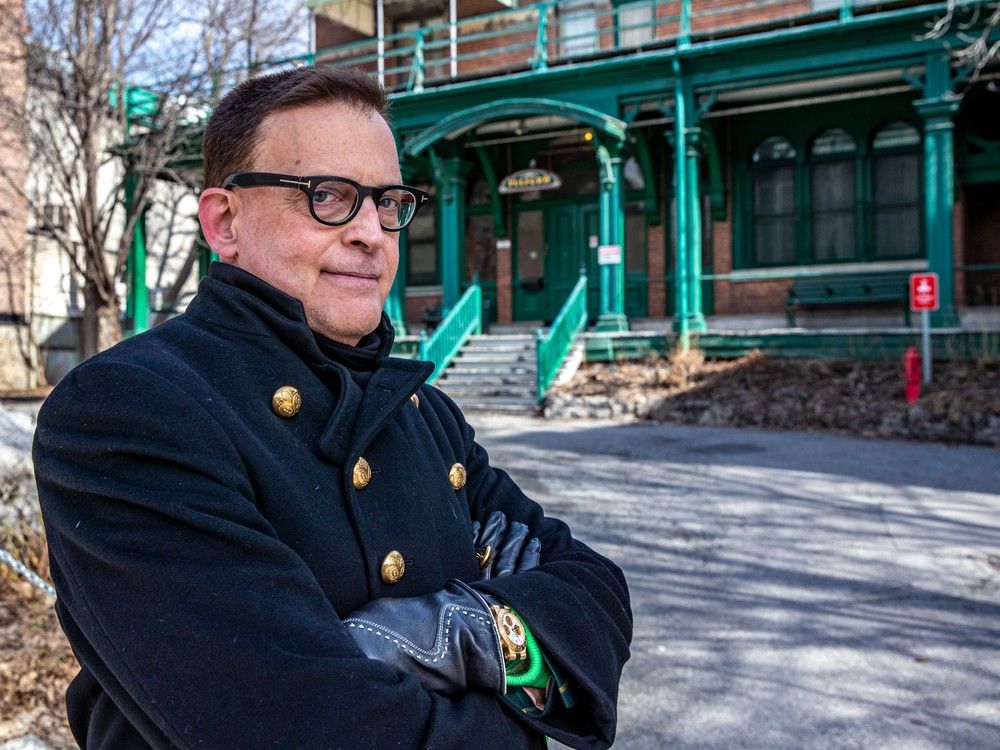
Lawyer Serge Sasseville, the independent city councillor for the Ville-Marie borough’s Peter-McGill district, where Fulford is located, and someone knowledgeable and passionate about heritage properties, is concerned that the landmark is uninhabited.
“I am beginning to be worried about the state of the building,” he said in an interview. “In June it will have been closed for two years. When you don’t occupy a heritage house, the decay begins.”
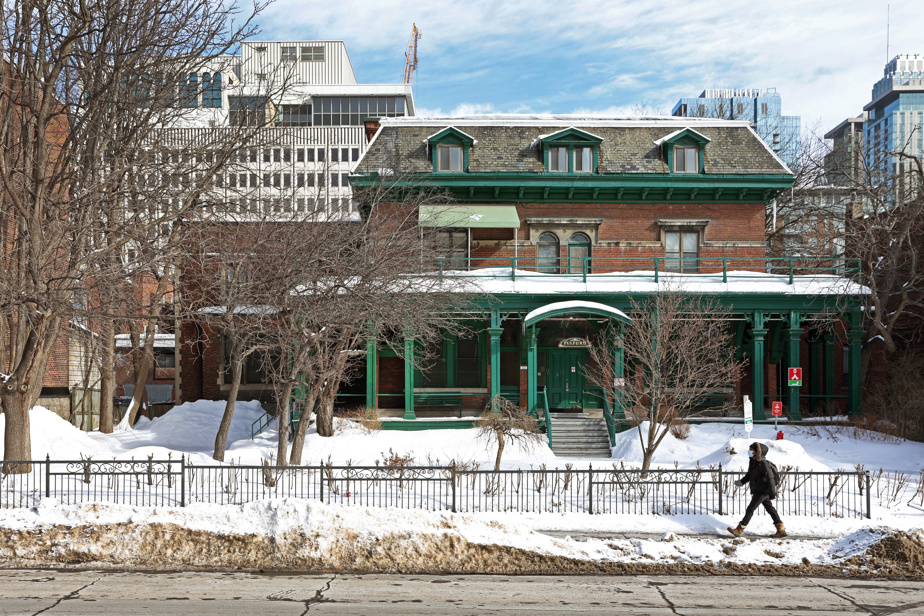
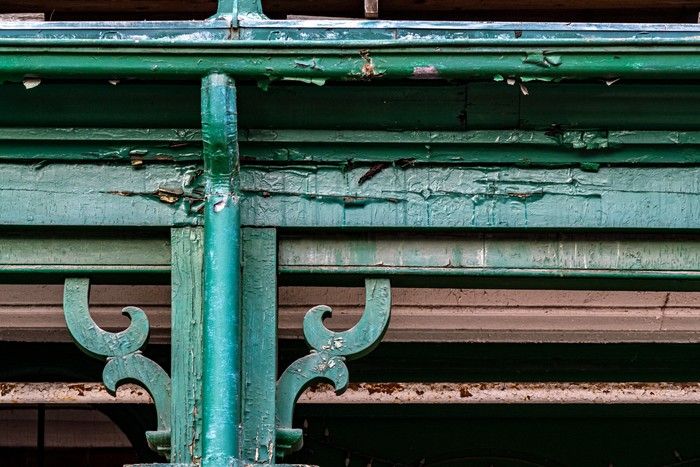
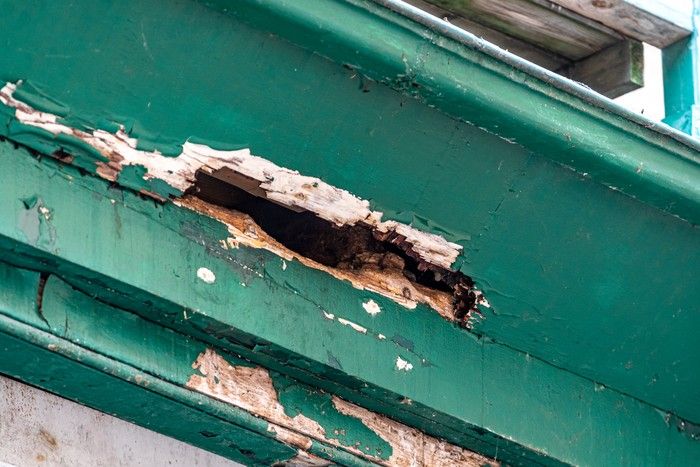
This week, for instance, he noticed badly peeling paint on the massive wooden beams of the raised veranda, one of the most interesting architectural elements of the 19th-century building. “So the wood is now exposed to the snow, the rain, the sun, the wind, the pollution — unprotected,” he said.
The building is exposed in other ways. It had been vacant only a short time when an unhoused woman broke in through a window, threw things around and went to sleep in one of the rooms. The alarm system detected someone inside and, when police rang the doorbell, she answered. There were also reports of unhoused people sleeping on the Fulford porch.
“It is important for me, as a heritage lover, to preserve that house … which bears witness to the birth of the Golden Square Mile,” Sasseville said.
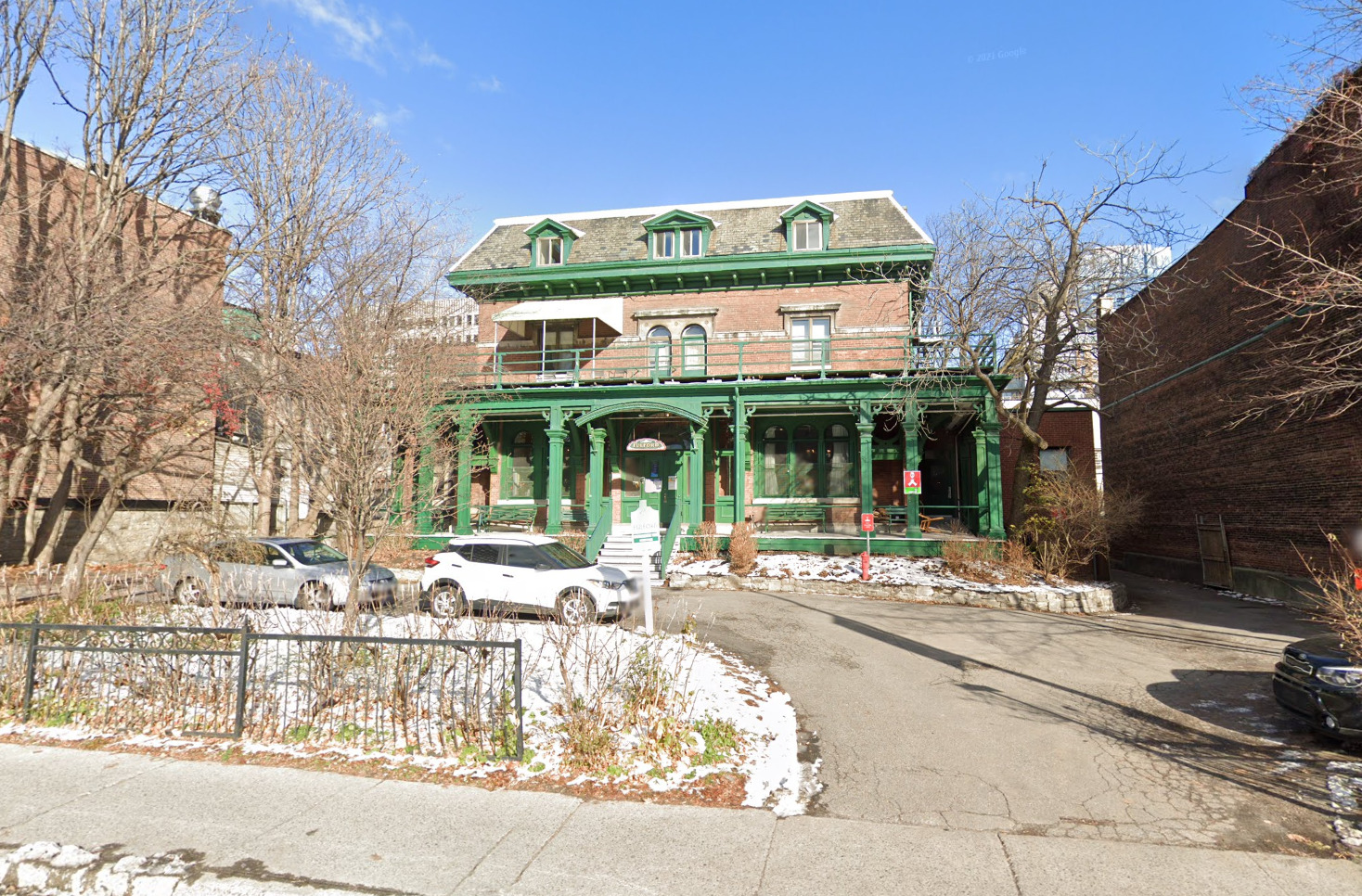
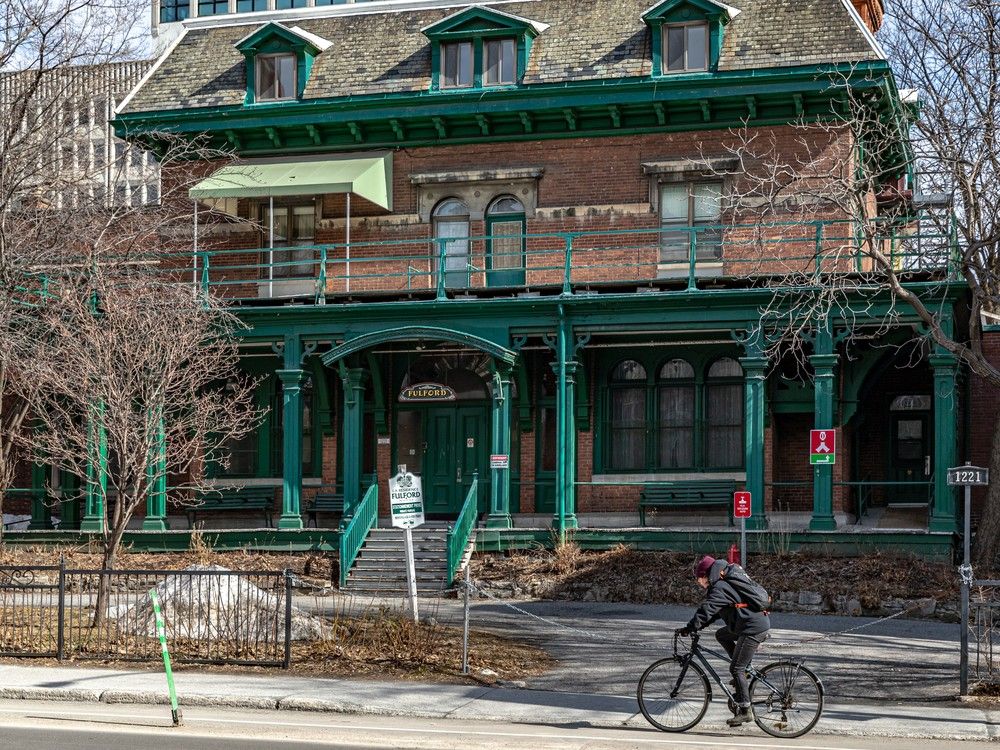
Built when Guy St. was just a country road cutting through orchards and farmland, the 1859 house is one of Montreal’s last surviving brick buildings from that era, he said. With its raised veranda, beautiful stained glass windows featuring the initials of the person for whom it was built, potash inspector James Edward Major, and the white marble fireplaces favoured in fashionable homes of the period, it is a unique witness to the city’s past.
Last August, in response to a request from Heritage Montreal and founding president Phyllis Lambert, Quebec’s culture and communications ministry announced its intention to give heritage protection to the Major House by classifying the property, the building and parts of its interiors which are “of particular architectural integrity and interest.”
No decision is expected before at least early 2024; meanwhile, the owner must act as if the property has already been classified. Heritage classification, of course, changes the possibilities for developers: It means they can’t tear the building down.
Although the Anglican bishop is president of Fulford’s board and despite what many think, the church owns neither the land nor the building. Fulford’s owning corporation is a not-for profit organization, Résidence Fulford/Fulford Residence, governed by the provincial corporations act.
David McEntyre, vice-president of the Fulford board, and board director Pam Davidson McLernon, a real estate agent, make up the building committee charged with developing proposals from prospective buyers for the property, with lawyer Valérie Mac-Seing as real estate counsel.
Parties who have expressed interest — it’s not clear how many there are — have signed non-disclosure, or confidentiality, agreements, so they’re not talking.
On behalf of Fulford, Mac-Seing recently described the sale process as “private and confidential. As such, we have no comment.”
Responding for Fulford board president Mary Irwin-Gibson, Bishop of the Anglican Diocese of Montreal, Episcopal secretary Maria Abate wrote in March: “Bishop Mary is not involved with the current part of the negotiations. As far as she knows, there is no news to date.”
Still: The fate of a valued community property and an important architectural landmark has been up in the air for the better part of two years — and there is no news to date?
Concordia University has long been eyeing the Fulford property — it reached out to Fulford in 2018 about relocating the residents, although that did not come to pass — and is believed to have submitted a proposal to buy it. There is speculation that the university’s bid for Fulford would involve the Old Brewery Mission, a resource for unhoused men and women, using the property as social housing for women.
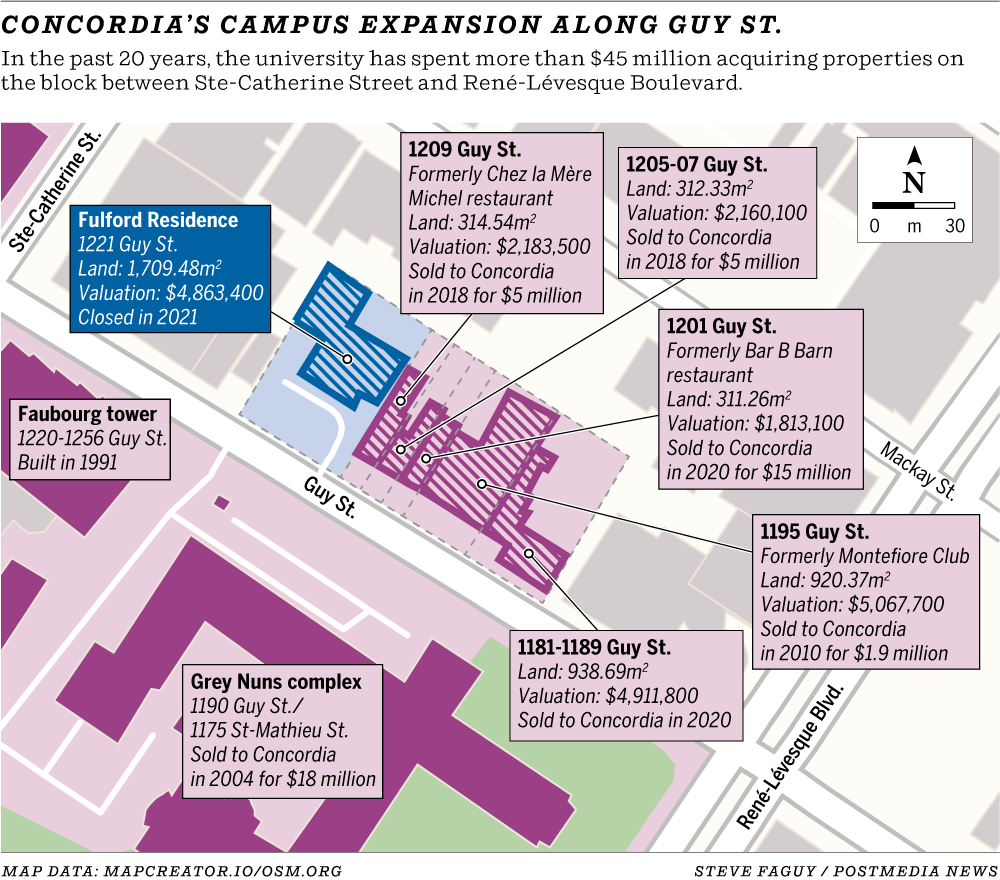
Concordia already owns much of the Guy St. block south of Fulford and north of René-Lévesque Blvd., including the site of the former Chez la Mère Michel and Bar B Barn restaurants and the venerable Montefiore Club, which closed in 2010. On the west side, the university owns the Faubourg Tower and sprawling former Grey Nuns Mother House complex.
Sasseville is concerned about continuing decay should the university buy the Fulford building and leave it vacant, as it has other buildings it owns on the east side of Guy St. “If Concordia buys it and does nothing, just sits on it, the same thing will happen,” he said.
Some observers have suggested the university is “banking” the land as part of a future development plan for its downtown campus. Concordia isn’t saying. “We do not discuss our interest or non-interest in any real estate,” spokesperson Vannina Maestracci said in an email.
In 2021, following the decision to shutter Fulford and relocate its residents, the executive director of Chez Doris, a downtown organization which helps women in distress, reached out to Fulford’s Irwin-Gibson to express interest in having Chez Doris buy the property; Marina Boulos-Winton was asked to submit a proposal. Unhoused women represent fully 80 per cent of Chez Doris clients, up from 20 per cent not that long ago: Its 24-bed emergency overnight shelter, which opened last September, is alway full.
Like Fulford, Chez Doris is in Sasseville’s district. He is impressed by its work on behalf of vulnerable women and understands the need is great. “It’s a neighbourhood where we need more buildings for women in difficulty — and Chez Doris is the perfect organization to buy and operate the Fulford Residence,” he said.
Fulford was founded in 1855 by Mary Drummond Fulford, wife of Montreal’s first Anglican bishop, Francis Fulford, “for the counsel and protection” of single women arriving from abroad to work, mainly as governesses and schoolteachers. Its vocation evolved over time, but its social and care vocation have remained constant: to care for women who need to be cared for.
“Mrs. Fulford dedicated the house to helping women to get their bearings and it has always been dedicated to some social purpose,” architecture icon Lambert said this week. “It seems to me it should remain that way.”
Board directors “could come off as heroes and the Fulford mission could be perpetuated,” Lambert said. “In the meantime, they are doing something for the city — and for people, who make up a city. Why is it better to sell it for the most money, this place that has had a social mission forever and has it now? You would think they would want to perpetuate that mission.”
City councillor Serge Sasseville said Concordia University has other buildings it owns on the east side of Guy St. that it bought and left empty. “If Concordia buys it and does nothing, just sits on it, the same thing will happen.” PHOTO BY DAVE SIDAWAY /Montreal Gazette
Sasseville said the Fulford building would be a suitable living space for Chez Doris clients, who are younger and more mobile than Fulford’s former residents — and that its large community space could be used to provide services for women who don’t necessarily live there. “It would be the perfect place to offer free meals to vulnerable women as well as social and recreational activities,” he said.
Jo LaPierre, a long-serving Fulford director who was dropped this year from the board, said she repeatedly expressed concern at meetings that the board had not ranked or thoroughly debated terms of reference for selling the property before offers were solicited — and that there was little discussion by directors of Fulford’s history or the community’s need. Characterizing the board as “docile,” she said she was the only one who spoke up at meetings, which rarely lasted more than an hour.
LaPierre, a historian and retired Dawson College professor, said McEntyre told her the executive and board had “lost confidence” in her because she’d broken her confidentiality agreement regarding the sale of the Fulford property. Dismissing the allegation as “invalid,” LaPierre said in a statement she read at Fulford’s 2021 annual general meeting, held in February of this year, that building committee members McEntyre and Davidson McLernon and the Bishop were “aggrieved over me questioning the process they have adopted to manage” Fulford’s sale.
An option favoured by some board directors seems to be selling the property to the buyer who would pay the most for it; an endowment could then be created, with proceeds from the sale used to make charitable grants. The board would take on more of a foundation role — and the social mission of Fulford will have ended.
Another, hybrid, option would be to sell the property to an organization with a use for it consistent with Mary Fulford’s original social mission — but at a discount which would make it affordable. The Grey Nuns sold their Mother House property to Concordia in 2004 for $18 million — far less than selling to developers would have yielded: They said it was important to them to sell to an organization that shared their education mission and would preserve the landmark.
With grants and other funding, Boulos-Winton said back in 2021, Chez Doris could afford to pay more for the Fulford property than its municipal evaluation, currently about $4.86 million. She acknowledged at the time that Concordia has “much deeper pockets,” but said the social mission of Chez Doris, caring for vulnerable women, is aligned more closely with Fulford’s.
Yet LaPierre said in her statement that Fulford’s building committee has shown a “repeated focus on getting the best price and ignoring all other aspects of the sale.”
To her, this represents “a matter of bad governance by a very small group.”
Meanwhile, the building stands vacant, its future and the place of Mary Fulford’s legacy still undecided.
Fulford’s interior, photo by Brian Merrett, courtesy of Heritage Montreal.
Pandemic sealed Fulford’s fate
Fulford is a unique witness to Montreal’s past in terms of its remarkable physical survival but also in terms of its continued social and care vocation, observed Heritage Montreal secretary Bruce McNiven. It was established at a time when health and welfare initiatives like Fulford operated almost exclusively outside the government realm in Quebec, he explained. They were created and managed by religious institutions — the Roman Catholic Church in the French-speaking milieu — or charitable initiatives of private citizens in the Protestant and English-speaking community and often led by women.
Fulford took over the Major House on Guy St. in 1890, moving from smaller quarters elsewhere downtown, and for many of the 131 years that followed, older women lived autonomously and happily in an environment that was more boarding school than seniors residence, with activities and outings.
But as community resources developed to help people age in their own homes, women entered Fulford much later in their lives. By then many had lost their autonomy and Fulford was not equipped to accommodate them: Most of its 38 rooms were too small to manoeuvre a wheelchair, for one. Just five rooms had private bathrooms. There was only a single, small, elevator. Occupancy declined and, with it, revenue.
In early 2021, the coronavirus pandemic sealed Fulford’s fate when it took the lives of 10 of its 31 residents. With 17 vacant rooms and the prospect of a continuing decline in occupancy, the board voted, reluctantly, that February to shutter the residence and relocate the women who had called it home. By June, they had all left.



 Une annonce bienvenue pour une fin heureuse !
 Chez Doris et la Résidence Fulford s’entendent pour créer une ressource pour les femmes vulnérables de Montréal
 « Après la décision du gouvernement du Québec, à la demande d’Héritage Montréal et de Phyllis Lambert, de classer la Résidence Fulford, aussi appelée la maison Major, son site et certains de ses intérieurs patrimoniaux documentés par le photographe Brian Merrett, l’annonce de son acquisition par l’organisme Chez Doris
  Toutes les photos de cette publication sont de Brian Merrett, 2021