Demander des modifications alors que tout ce qu’on a, c’est un corridor très approximatif, c’est du théatre.
2 « J'aime »
Apparemment ALTO à commencer à envoyer des brochures pour pouvoir faire des analyses environnementales et ça s’agite fort sur les forums…
Est-ce que quelqu’un avec de l’expérience légal peut me dire si ALTO peut forcer la collecte de données? Je veux dire si une majorité de personnes refusent l’accès ils font quoi et est-ce que cela peut amener des délais?
I’m not an expert on this, but from what I understand their refusal doesn’t override statutory survey rights. The Trespass to Property Act does not override other laws that grant entry rights, laws which will probably be created for ALTO to begin construction. Survey crews are under legal authority and don’t have to follow signs on properties that say “No Trespassing” they have to just give a time in advance that they are passing and there’s nothing to do to stop them.
I had a family member who lived on a farm and got very mad when he heard Manitoba Hydro had to create a new line that would go through his property. He got mad and acted similarly to these people, but it did nothing, they installed it anyway, and there was nothing he could do legally to stop it.
I think the same will be true here. The vocal minority are upset because they have a misunderstanding of the project, share their opinions online where the news and even here it’s picked up as being a “big deal” when it’s likely only a few dozen people.
9 « J'aime »
People in the comments of these posts are talking about shooting down drones and threatening surveyor’s with firearms, definitely sane and normal.
6 « J'aime »
Let’s say I took the extreme exemple, but my question was more general, do the fact that some owners refuse the access to their lands for environmental assessments could slow down the project?
If we go ahead and do normal surveying, ignoring the “battle” online with these people, it probably won’t be slowed down much.
But based on how certain politicians do things for the populous votes (instead of focusing on what is better economically, environmentally, sustainably), things could change. Le Bloc already talking about it for Terrebonne is an example of this
I don’t really agree with that. I’m all for the project, but for them it’s different as they will be living with the negatives and they might not even benefit from it.
I think it’s normal to be upset if your land is being cut in half and you’re not being compensated (enough). It’s Alto’s (and the government) to find a way to please as much people as possible. I don’t think that saying to people that it is for the greater good really makes any difference in the life of people who are directly affected by the project.
I think we agree, people can be justified in being upset, but the scale of opposition I think is overstated. There will always be NIMBYs everywhere
Yes of course, and also people react differently when confronted by something that affects their comfort or the way they are used to live. In project management, it’s a major aspect to take into account. I just hope nobody at Alto and/or the government is surprised by that
1 « J'aime »
I hope as well, I don’t want to live through another REM de l’Est haha
3 « J'aime »
And it’s so easy to imagine the most negative outcomes and not the positive ones. When I chatted with some of those folks, a few of them didn’t realize that they could leverage Alto to deliver indirect benefits. Short of hijacking the project like Kingston or Mirabel, I haven’t seen much demands for simple items, like pairing alto civil work with local street and infra upgrades, setting up a social utility trust, building community amenities along the corridor, securing regional supply and construction jobs, turning access roads into brand new AAA trails, or reserve ROW to build a commuter and rural rail network.
15 « J'aime »
J’aimerais surtout voir les opposants à Alto proposer de réelles alternatives pour faciliter la mobilité dans le Corridor , avec une enveloppe budgétaire comparable, ou moindre.
Là on aurait un débat de société pertinent et productif, pas en pleurant parce qu’on exproprie un corridor de 20m de large sur une ferme qui existe depuis les années 1800.
La réalité c’est que le Corridor a une population de 18 millions, en expansion, est globalement très mal connecté et il y a un évident déficit en terme d’infrastructures de transport qui datent pour la grande majorité des années 60-70.
La question ne devrait pas être sur des batailles de clocher, ou du NIMBYisme mais plutot sur une vision de l’avenir de cette méga-région.
Juste pour le fun, j’ai demandé à Gemini de chiffrer un plan alternatif avec un budget d’environ 100 milliards basé sur du transport routier et aérien pour l’intercité et des améliorations aux réseaux de transport lourds de chaque agglomération (Toronto, Ottawa, Montréal, Québec):, en proportion de leur population respective.
Interurbain
- Élargissement d’une voie par direction de la 20/401: 35 milliards
- Nouvel aéroport à Pickering: 12 milliards
- Nouveau terminal passager à Mirabel (15 portes d’embarquement) & Prolongement de l’A13: 4 milliards
Local
- Toronto: 26.6 milliards
- Montréal: 16.95 milliards
- Ottawa 5.78 milliards
- Québec: 3.28 milliards
Cela financerait donc des projets comme l’Ontario line, le GO RER, incluant la desserte du nouvel aérport, le REM de l’est et REM Laval/Rive nord, le prolongement du Otrain (notamment optimiser la desserte directe du centre-ville/aéroport, un train de banlieue/prolongement du tram à Québec, etc.
C’est avec ce genre de popositions (évidement plus sérieusement étudiées qu’un simple prompt AI) que les débats devraient se tenir. 100 milliards ce n’est pas rien.
Est ce que Alto est la meilleure idée, peut être ou pas. La seule alternative qui a été sérieusement étudiée c’est le fameux TGF qui était une mauvaise idée, ou une option “no-build”.
Realistically, for a project of this scale, it won’t make much of a difference. Nowadays, we’ve got satellites that can take measurements within a centimeter from space. A difference of a centimeter in land elevation won’t make much of a difference on a project of this scale at the route planning stage. It will start to matter when we start planning individual structures such as bridges and overpass. By then, expropriations will likely have started and construction won’t be far behind.
1 « J'aime »
La Chambre de commerce et d’industrie Les Moulins a organisé un débat entre Nathalie Sinclair-Desgagné et Tatiana Auguste. Alto n’a pas vraiment été abordé… peut-être que ce n’est pas tant la question de l’urne que croit le Bloc.
2 « J'aime »
Dans la Presse
Projet de TGV entre Québec et Toronto | Division aux Communes, malgré un fort appui de la population
Le débat politique entourant le projet de construction d’un TGV entre Québec et Toronto s’envenime. Ce projet ambitieux pourrait s’imposer comme la question de l’urne durant l’élection partielle qui aura lieu le 13 avril dans la circonscription fédérale de Terrebonne – un vote qui pourrait donner la majorité au gouvernement de Mark Carney.
Le Parti conservateur a fait savoir qu’il s’oppose farouchement à ce projet, le qualifiant de « monstruosité » en raison de la facture qui pourrait friser les 90 milliards de dollars. Le Bloc québécois, lui, s’indigne de l’absence de réponses claires concernant le tracé et les possibles expropriations. Le gouvernement Carney maintient toutefois le cap, soulignant que la majorité des Canadiens souhaitent l’aboutissement de ce projet « visionnaire » qui est piloté par la société d’État Alto.
Un nouveau sondage mené par la firme Abacus Data auprès de 1515 Canadiens du 19 au 24 mars démontre que 62 % des Canadiens appuient ce projet et que seulement 18 % s’y opposent, tandis que 20 % affirment être incertains ou souhaitent obtenir plus d’information.
[…]
I guess Gemini didn’t know.
Anyway, if some nimbys tell you “we should do xyz instead of abc!”, you can point to governments with enough good sense to do both.
1 « J'aime »
La présentation des résultats du sondage d’Abacus est dispo dans ce pdf : https://www.altno.ca/_files/ugd/f1a60d_f91a3f0ada144cb981f03a0da603e347.pdf
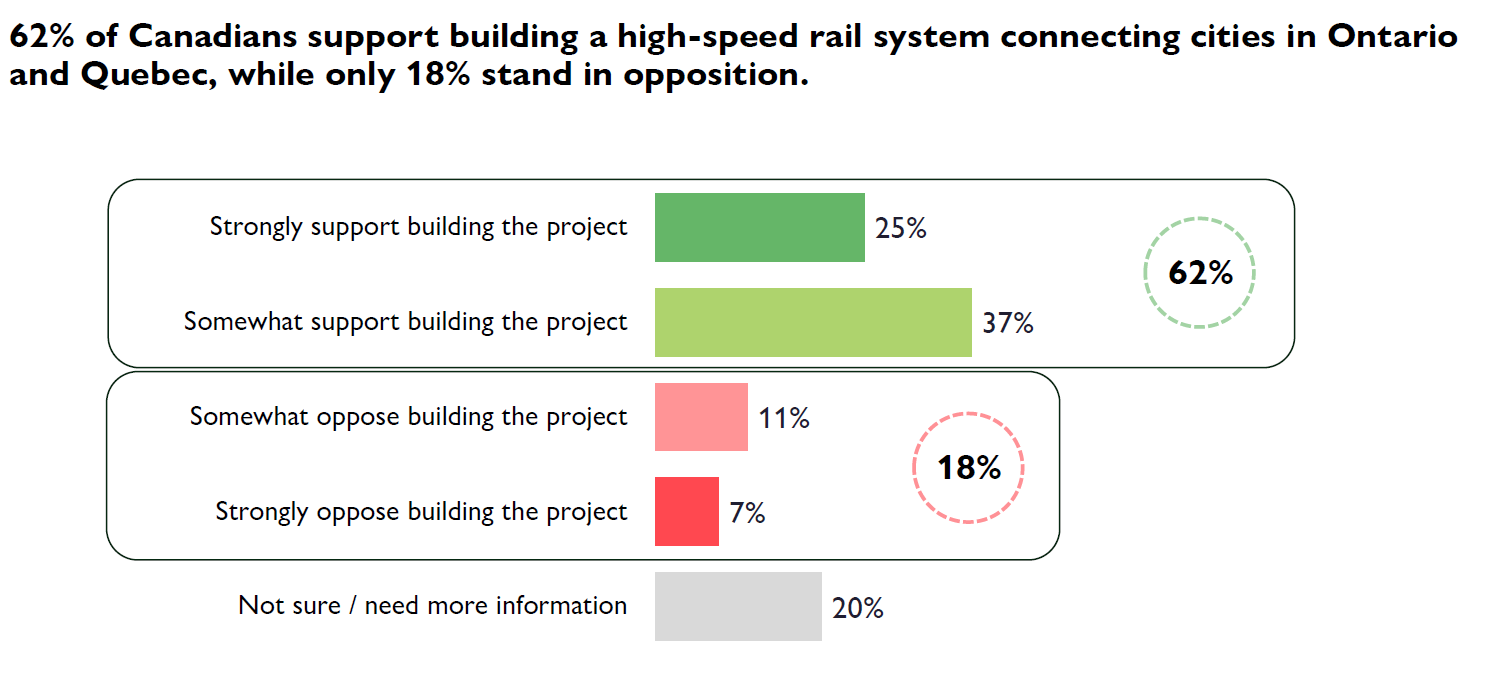
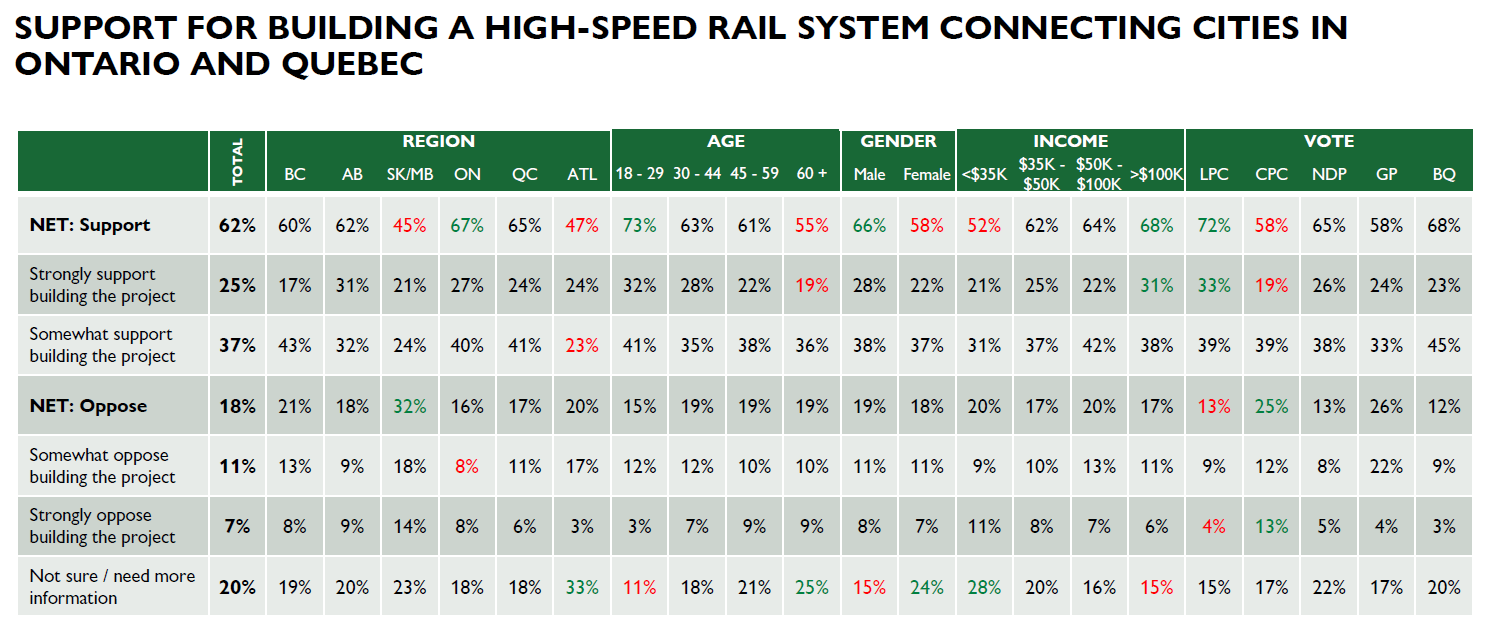
L’électorat du Bloc est en faveur du projet à 68 % 
18 « J'aime »
Envoyez ça à Pierre Poilievre lui qui voulait tant séduire les jeunes…
3 « J'aime »
Quand même chez les conservateurs, la majorité est en faveur ! Ce qui est le plus surprenant, c’est que les électeurs le plus en défaveur sont du parti vert !
Je demeure surpris de l’appuie de la Colombie-Britannique et de l’Alberta, considérant qu’ils ne sont pas desservi par le service. Peut-être une prochaine phase !
5 « J'aime »
Le parti Vert est un parti qui a généralement plus à coeur la protection de l’environnement (la nature, les écosystèmes, la biodiversité) que la protection du climat (les GES).
Plusieurs de leurs positions historiques le montre (opposition au nucléaire ou à la construction de certaines autres productions d’électricité décarbonée par exemple)
En même temps la marge d’erreur est énorme sur ce sondage pour le PV (genre 15%), donc il faut faire attention avec ces chiffres
3 « J'aime »