Situation exceptionnelle qu’il dit
“I’ve been doing projects for 40 years, including 20 years of mega projects internationally. I’ve never seen a situation as difficult as the one we’ve experienced over the last two years,” says CDPQ Infra executive.
‘Exceptional’ challenges behind delay for South Shore REM stations, CDPQ Infra says
‘I’ve never seen a situation as difficult as the one we’ve experienced,’ CDPQ Infra executive says
Antoni Nerestant
CBC News · Posted: Oct 21, 2022 12:18 PM ET | Last Updated: 20 minutes ago
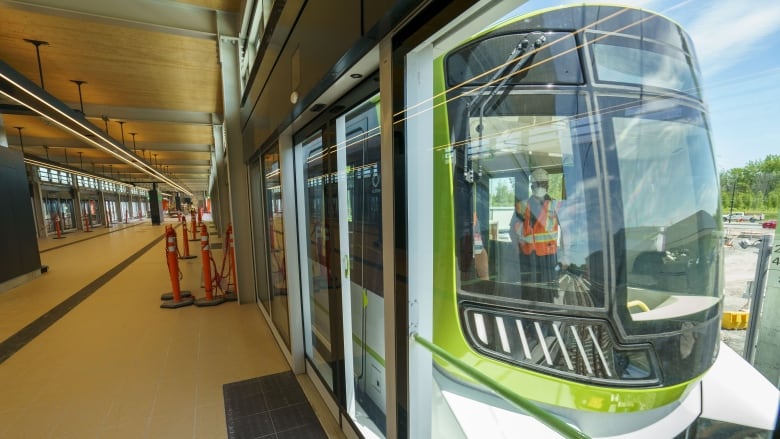
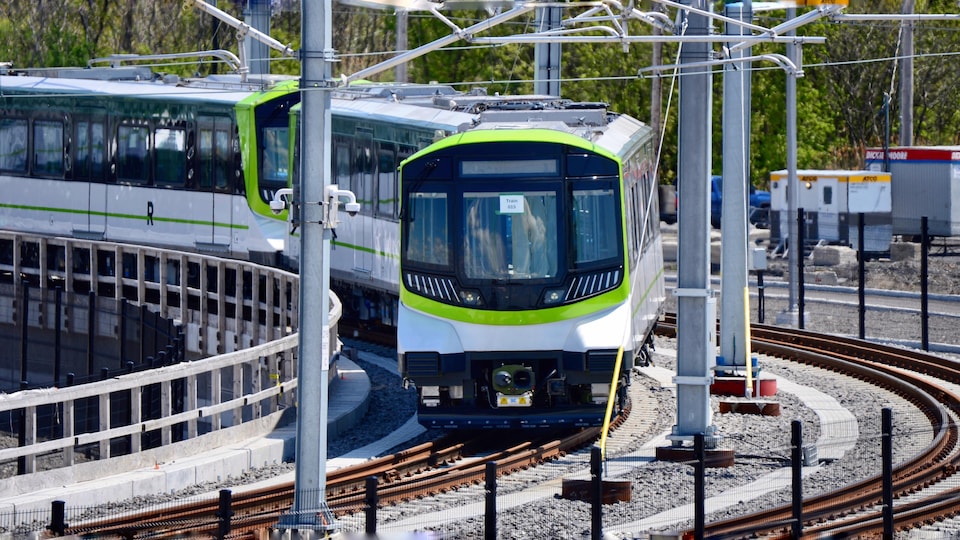
In this photo, a train rolls into a station during a media tour of the light-rail train network in Brossard, Que. The opening of the stations on Montreal’s South Shore has once again been delayed. (Paul Chiasson/The Canadian Press)
The grand opening of Montreal’s future light-rail network has been delayed once again and the group in charge of building it says “exceptional circumstances” like the global pandemic and Russia’s invasion of Ukraine have made it nearly impossible to deliver the project on time.
On Friday, CDPQ Infra — which is a subsidiary of Quebec’s pension fund manager, the Caisse de dépôt et placement du Québec — confirmed during a news conference Friday that the five South Shore stations of the Réseau express métropolitain (REM) won’t open before the spring of 2023.
From the station near Quartier DIX30 on Montreal’s South Shore, the electric train is slated to have two stops as it heads north, crosses the Champlain Bridge and stops at Nuns’ Island before going downtown.
Originally, that portion of the REM was expected to be up and running last year. The timeline has been delayed several times since then. The opening of most of the other stations on the network has been pushed back to the end of 2024.
“Since 2020, the pandemic and the war in Ukraine have led to a certain number of consequences difficult to predict,” said Jean-Marc Arbaud, CDPQ Infra’s chief executive officer. He made references to inflation, supply chains and the labour shortage.
In the last two years, work crews have also had to deal with complications in the Mount Royal Tunnel, where century-old explosives were discovered.
“I’ve been doing projects for 40 years, including 20 years of mega projects internationally. I’ve never seen a situation as difficult as the one we’ve experienced over the last two years,” said Denis Rivard, who is the project’s vice-president.
“Personally, I am very, very proud of everything we’ve accomplished.”
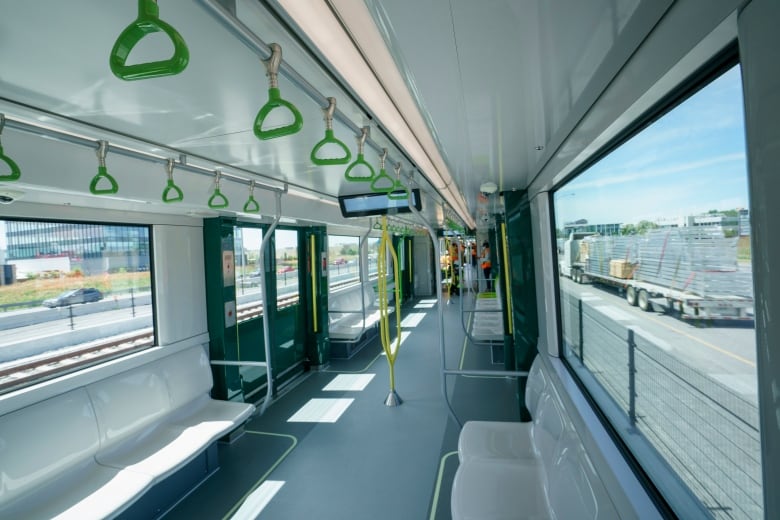
CDPQ Infra says it will spend the coming weeks testing the light-rail train system, making sure it’s reliable during the winter. (Paul Chiasson/The Canadian Press)
Friday’s announcement comes at a time when commuters heading to and from the South Shore are anticipating substantial delays when the province’s Transport Ministry shuts down three lanes in the Louis-Hippolyte-La Fontaine tunnel for at least three years.
“I am very empathetic with regard to the different problems in Montreal,” Arbaud said when asked if the company considered the tunnel lane closures before announcing the REM’s latest delay .
“Unfortunately, it’s not realistic to roll out the system before going through a certain number of steps that are fundamental… We have to do it and we have to do it well.”
Opening during winter possible but ‘far from ideal’, CDPQ Infra says
During Friday’s news conference, CDPQ Infra’s reprentatives stressed that the construction of the South Shore portion of light-rail network is all but done. Technically, Arbaud said, tests could be completed in time for the stations to be open in the a few months, but that would mean a rollout in the middle of the winter.
CDPQ Infra describes that scenario as being “far from ideal.” The group says it will spend the next few months making sure the transit system is as reliable as possible.
“In the coming weeks, we’ll be able to verify its endurance. We’ll be able to fine-tune the settings and ensure an increased reliability of the system in a winter environment,” said Julien Hurel, the company’s head of transportation systems.
The light-rail network is slated to have 26 stations in and around Montreal, covering a total of 67 kilometres.
https://www.cbc.ca/news/canada/montreal/rem-light-rail-network-south-shore-brossard-delay-1.6624701
La version Radio-Canada
Le contexte économique difficile bouscule la mise en service du REM
L’inflation, la pénurie de main-d’œuvre et les difficultés d’approvisionnement gonfleront la facture, estiment les responsables de CDPQ Infra.
La mise en service du tronçon de 16 kilomètres du REM qui relie Brossard à la gare centrale de Montréal est de nouveau reportée, cette fois jusqu’au printemps 2023.
PHOTO : RADIO-CANADA / JEAN-CLAUDE TALIANA
Stéphane Bordeleau
Publié à 12 h 05
Les responsables du Réseau express métropolitain (REM), qui annonçaient vendredi matin le report au printemps 2023 de la mise en service du tronçon Brossard/centre-ville de Montréal, ont évoqué d’importantes difficultés dont la pénurie de main-d’œuvre, l’inflation et le bouleversement des chaînes d’approvisionnement pour justifier ce nouveau retard dans l’échéancier du projet.
En point de presse vendredi matin, Jean-Marc Arbaud, président et chef de la direction de CDPQ Infra, a expliqué d’entrée de jeu que, depuis 2020, les effets de la pandémie et la guerre en Ukraine ont eu des conséquences importantes et difficiles à prévoir sur le déroulement du projet.
Une que vous vivez tous, tous les jours, c’est l’inflation. Tous les enjeux d’approvisionnement et de chaîne logistique et aussi la pénurie de main-d’œuvre, a évoqué M. Arbaud.
La flambée inflationniste et la perturbation importante des chaînes de transport dans le monde, notamment en raison de la guerre en Ukraine, ont également causé d’importants maux de tête à CDPQ Infra.
« Ça fait 40 ans que je fais des projets, dont 20 ans à l’international au niveau des mégaprojets. Je n’ai jamais rencontré dans ma vie une situation aussi difficile que celle qu’on vit depuis deux ans. »
— Une citation de Denis Rivard, vice-président du projet du REM chez CDPQ Infra
À ces difficultés contextuelles se sont également ajoutées des embûches qui n’avaient pas été prévues, notamment la découverte de charges explosives oubliées dans le tunnel du mont Royal, lors de sa construction, il y a plus d’une centaine d’années.
Pour contourner cet écueil, CDPQ Infra a dû recourir à de la machinerie robotisée qui fonctionnait à distance afin d’enlever les charges qui auraient pu exploser.
L’état de détérioration avancé de l’infrastructure a également nécessité davantage de travaux, ont expliqué les responsables de CDPQ Infra.
Hausse anticipée des coûts du projet
Questionné par les journalistes sur l’impact financier qu’aura ce nouveau report de la mise en service du REM, Jean-Marc Arbaud a reconnu qu’une hausse des coûts est prévoir dans les circonstances.
C’est certain qu’il y a eu des impacts financiers. On fera une mise à jour autour de la mise en service. Vous verrez que, compte tenu du projet, on vous démontrera la rigueur et la façon dont nous avons géré l’ensemble de ces enjeux liés aux coûts de l’inflation et du manque de main-d’œuvre, a déclaré le président et chef de la direction de CDPQ Infra.
Évalué à 5,5 milliards de dollars en 2016, le coût du réseau du REM a grimpé à près de 7 milliards de dollars en juin dernier.
En juillet dernier, on annonçait la première mise sous tension du tronçon de la Rive-Sud. Les 16 kilomètres de l’antenne de la Rive-Sud avaient alors été électrifiés entre le terminus de Brossard et la gare Centrale, à Montréal. Puis la mise en service a été reportée à décembre 2022 et maintenant au printemps 2023.
Une fois le tronçon Rive-Sud en service, les trains du REM permettront aux voyageurs de faire le trajet entre Brossard et le centre-ville de Montréal en 16 minutes.
 yep
yep ) une mise en service


